
User and Society

When I started my master’s journey, I understood User & Society primarily as designing solutions for human needs. Influenced by stakeholder-oriented approaches, I believed that designers should identify societal problems and develop interventions to improve existing situations. Through projects addressing social issues, I learned to shift perspectives between stakeholders and understand challenges from multiple viewpoints.
Over time, however, I began to question this problem-solving mindset. While stakeholder-centered approaches reveal different perspectives, they often position designers as the ones defining problems and deciding what solutions should be implemented. My engagement with the Reflective Transformative Design Process (RTDP) (Hummels and Frens, 2011) challenged this assumption by framing design as a process of reflection, reframing, and knowledge generation rather than linear problem-solving. Similarly, Participatory Design introduced the idea that participation is not simply about involving people in design, but about negotiating how participation itself is configured (Vines et al., 2013).
This shift became visible across projects involving low-literacy citizens, climate engagement, human–goose coexistence, and bodily awareness. Rather than designing solutions for users, I increasingly focused on creating situations that support reflection, interpretation, and interaction. My M12 project on human–goose coexistence further expanded my understanding of society beyond human stakeholders, encouraging me to consider animals and environments as participants with their own forms of agency.
To support this perspective, I adopted mental model mapping as a core research and design approach. First applied in M12 (see figure 1) and further developed in later projects, it enabled me to investigate how people’s assumptions, emotions, and interpretations shape behavior (Norman, 1983). This shifted my attention from observable actions to the meanings individuals construct through experience. Mental model mapping became the primary lens through which I investigate how people construct meaning from experience.
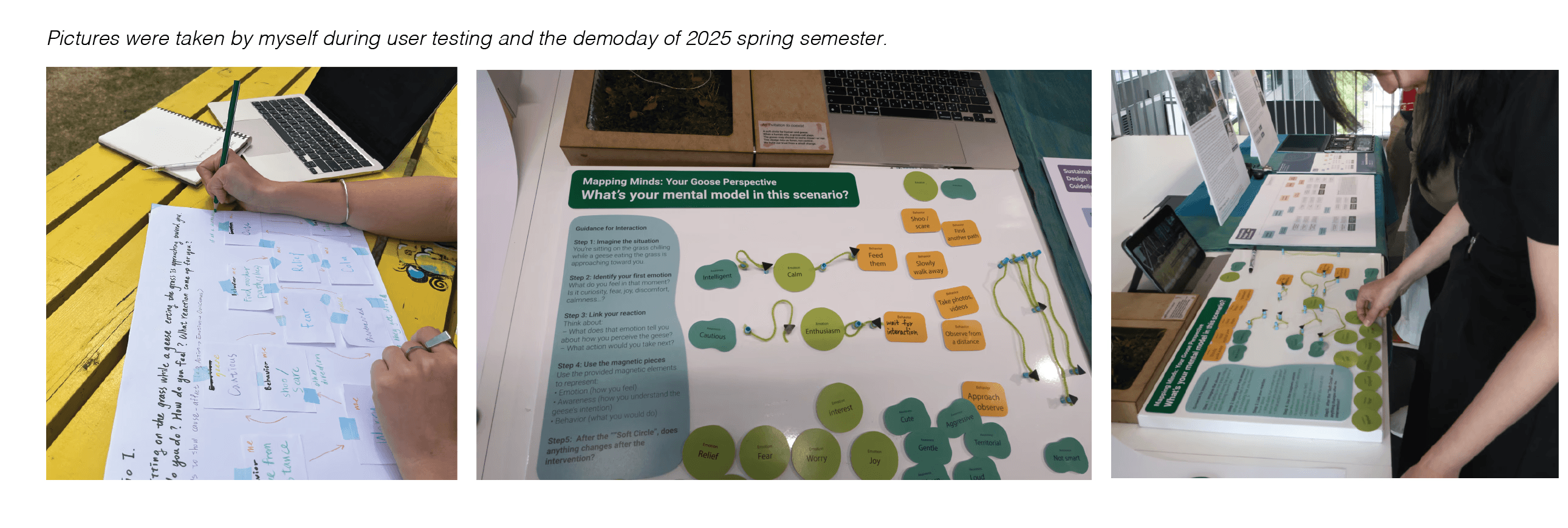
Figure Group 1.
My first mental model tool application (Picture on the most left) and I iterated it for M12 Soft circle project. (two on the right) People were invited to map their mental model before and after the intervention. By visualizing it, they could reflect on what had change during the process.
Another important influence came from Soma Design (Höök et al., 2016), which emphasizes first-person experience, bodily awareness, and personal interpretation. Rather than seeking universal solutions, this perspective encouraged me to leave space for participants to construct their own meanings. This became central to my Final Master Project, where the goal was not to optimize or correct behavior, but to support reflection on bodily experience. (see figure 2) Through these projects, I also learned that conventional interviews and questionnaires often struggle to capture tacit experiences, emotions, and bodily sensations. This motivated me to adapt and develop participatory methods that externalize invisible experiences and support reflection through making, mapping, and interaction.

Figure Group 2.
My FMP project was more concerntrated on how individual perceived, interpret, and reflect. Participants received prompts for reflection rather than predefined interpretations. This shift reflects my growing interest in creating conditions for meaning-making rather than directing behaviour.
Today, I see User & Society not as solving problems on behalf of others, but as creating conditions that support reflection, participation, and meaning-making. Throughout my master’s journey, my relationship with technology evolved from learning tools to using making as a way of thinking, exploring, and realizing experiential concepts. Across my projects, my role has gradually shifted from problem solver, to facilitator, and ultimately toward a mediator of interpretation, helping people construct their own understanding of themselves, others, and their environment.
Related courses and activities
DPM115 Project 1 Design
DPM120 Project 2 design research
DDPM210 Preparation Final Master Project
DDM150 User experience theory and practice
DCM130 Design for social innovation
DDM190 Interactional morality
DDPM220 Final Master project


Reference
Caroline Hummels and Joep Frens. 2011. Designing Disruptive Innovative Systems, Products and Services: RTD Process. DOI: 10.5772/22580
Vines, J., Clarke, R., Wright, P., McCarthy, J., & Olivier, P. (2013, April). Configuring participation: on how we involve people in design. In Proceedings of the 2013 CHI Conference on Human Factors in Computing Systems (pp. 429-438). DOI: 10.1145/2470654.2470716
Norman, D.A. (1983). Some observations on mental models. In D. Gentner & A. Stevens (Eds.), Mental models (pp. 7-14). Hillsdale, NJ: Erlbaum. https://www.taylorfrancis.com/chapters/edit/10.4324/9781315802725-2/observations-mental-models-donald-norman
Höök, K., Jonsson, M. P., Ståhl, A., & Mercurio, J. (2016). Somaesthetic AppreciationDesign. Proceedings of the 2016 CHI Conference on Human Factorsin Computing Systems, 3131–3142. DOI: 10.1145/2858036.2858583